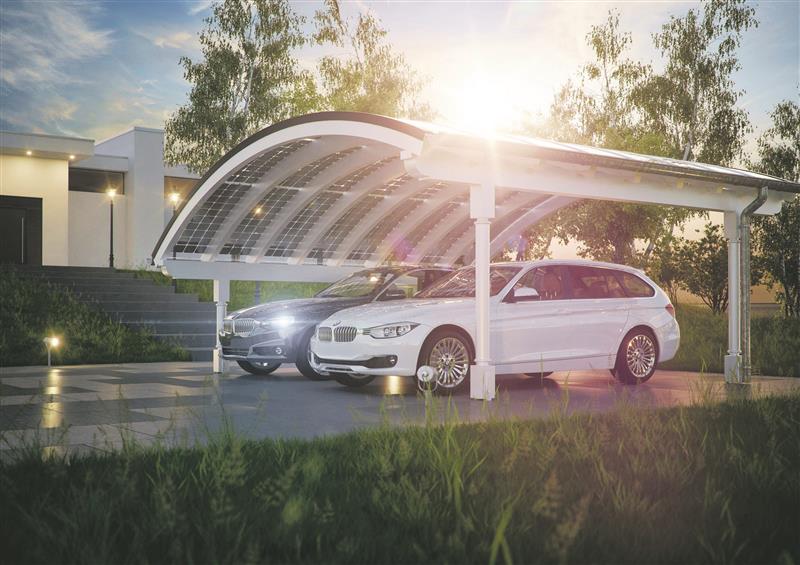
So-called "solar carports" don't just charge the electric car when parked.
They can also reduce the electricity bill.
Whatever your opinion on the subject, electric cars are the future of road traffic. The number of new registrations of fully or partially electrically powered cars is also slowly but steadily increasing in Mallorca.
One of the main reasons why many potential car buyers are still hesitant about brands such as Tesla & Co. is the insufficiently developed charging infrastructure. So the question usually remains: how and where can the vehicle battery be recharged? The most sensible and cheapest way to do this is in front of your own home - with your own solar carport. Motto: Park – and charge the car üvia the photovoltaic panels installed on the roof. A fast charger gets an electric car ready to go in less than three hours. And just 15 square meters of solar panels are enough to provide the equivalent of 17,500 kilometers of driving per year.
Another advantage: the electricity produced on the carport during the day can be temporarily stored in batteries and fed into the home grid. In practice, the average daily mileage of a car is only around 40 km, which is only a small proportion of the enormous battery capacity. Most of the time, the vehicles remain parked. These quasi-stationary electricity storage units could be used to draw a multiple of the average household electricity consumption of around 8 to 9 kWh per day from the parked car.
And: If you don't have space for a carport, you can alternatively use other suitable areas to charge your electric car. Environmentally friendly electricity can also be produced from the patio roof or balcony cladding.
Editorial team