












Pool construction on Mallorca: first tweak, then dig
A pool adds value to a property – if permission, land, water and technology are considered together from the outset
A pool quickly looks simple on the plan. A rectangle in the garden, a technical room next to it, a few pipes, later water, light and perhaps a cover. In Mallorca, however, the actual planning doesn't start with the shape of the pool, but with a much more important question: What does this piece of land even allow for? Because a permanently installed pool is not a mobile garden element. It encroaches on the ground, requires technology, water, electricity, drainage and usually additional paved areas. This is precisely why the issue ends up not only with the pool builder, but also with the architect, the ayuntamiento and - depending on the location - with other specialist bodies.
He who prepares properly wins. If you build too early, you risk getting into trouble: with the municipality, when selling later, when financing or when legalizing old properties. With fincas and existing properties in particular, the pool is often more than just a matter of convenience. It is a point of reference in terms of building law.
Why a pool in Mallorca usually needs a license
For a permanently installed pool, a licencia urbanística, i.e. a municipal building permit, is usually required. The Ayuntamiento of the municipality in which the property is located is responsible. The Balearic urban planning legislation covers structural interventions, earth movements, installations and the use of land; a new, in-ground pool almost always falls within this area. In practice, this means that it is not the property photo that is decisive, not the free area in the garden and not the statement "the neighbor could have done it too". The decisive factors are the municipal planning, the soil class, the existing development, possible protected areas and the question of whether the permitted land use has already been exhausted.
Licencia or comunicación previa: The small difference with a big impact
The comunicación previa, i.e. prior notification to the administration, is often used for construction work on Mallorca. It may be sufficient for smaller, clearly limited work. Care must be taken with a new pool. Excavation, pool construction, technical room, pipes, drainage and possible changes to the terrain often speak in favor of a classic licencia urbanística. The LUIB stipulates that the administration can stop work if, following a comunicación previa, it becomes apparent that the project actually requires a license or further approval.
For owners, this means that it is not the fastest route that is best, but the legally appropriate one. If you start off on the wrong foot, you rarely save time. They usually lose it later on.
The technical room belongs in the planning - not in the remaining space
Many pool projects spend too much time thinking about the pool and too little time thinking about the technology. Yet it is precisely this area that determines whether the pool will function well in the future. The filter system, pump, controls, water treatment, power connection, maintenance access and drainage need space, protection and a sensible location. The technical room can also be relevant in terms of building regulations. It is not just a box that you put somewhere. Depending on the design, location and size, it may be part of the measures requiring approval. The same applies to walls, patio areas, steps, borders or larger landscaping.
Good planning therefore not only asks: How big will the pool be? But also: Where does the technology run, how is it maintained, where does the water go and what is subject to approval?
Suelo urbano: simpler, but not automatically free
On urban building land or in urbanizations, pool construction is often easier to calculate than on rural land. Nevertheless, there is no automatic permission here either. The municipality checks whether the project is compatible with the applicable planning. Relevant factors include distances to neighbors, the permissible plot occupancy, existing outbuildings, terraces, roofs, technical rooms and possible specifications of an owners' association. In the case of older houses, there is another question: Is the existing building properly documented? This point in particular is often underestimated. A new pool can lead to the building file of the entire property being examined more closely. If old extensions, unregistered terraces or deviating areas then appear, the pool project can quickly turn into a major clarification of the existing situation.
What owners should look out for in the suelo urbano
| Question | Why it is important |
|---|---|
| Are there still areas that can be built on? | Pool, technical room and ancillary areas may be relevant under planning law. |
| Are the boundary distances correct? | The location of the basin is often more limited than expected. |
| Is the stock clean? | Old undocumented buildings can make approval more difficult. |
| Are there community rules? | In urbanizations or residential complexes, additional requirements may apply. |
| Is there a protected area? | Küstennähe, monument protection, tree protection or special zones can trigger further tests. |
Finca with pool: clear boundaries apply in suelo rústico
Fincas are much stricter. In the suelo rústico, pool construction in Mallorca is strictly regulated. The Ley de Urbanismo de las Illes Balears expressly states that no more than one pool per finca may be built in detached houses in rural areas. New pools may have a maximum water surface area of 35 square meters and a volume of 60 cubic meters. This requirement is crucial for many projects. A finca can appear large, the garden spacious, the area seemingly unproblematic. In terms of building law, however, it is not the amount of space that counts, but the permissible use of the land.
The exact classification of the land is particularly important. The Plan Territorial de Mallorca distinguishes between different categories in the suelo rústico. If several categories come together on one plot, the appropriate usage regime must be observed for the affected part. This is the point at which planning and reality often diverge. A pool on a finca is not decided first by design, but by soil class, inventory, size, water and landscape integration.Poor locations: beautiful plots of landcorner, stricter questions
Many of the sought-after rural properties are located in sensitive zones: Slopes, landscape conservation areas, proximity to torrents, coastal strips, woodland or other protected categories. It is not just a question of whether a pool is possible in principle. It is also about visibility, earth movements, walls, sealing, light, water flow and landscape impact. A pool that would be relatively uncomplicated in an urbanization can trigger additional approvals, expert opinions or restrictions in rural areas. Projects in which not just a pool is created, but an entire outdoor concept with terraces, walls, pergolas, technical buildings and lighting are particularly critical.
For owners, this is no reason to panic, but a good reason to follow the right sequence: first check the ground, then design it.
Water: The point that changes pool construction in Mallorca
Mallorca is no longer just discussing building law when it comes to pool construction. Water has become a central planning issue. The LUIB now contains specifications for reducing water consumption. New buildings and comprehensive reforms must include water-saving installations; construction projects in the suelo rústico should collect rainwater from roof areas and reuse it for buildings or fincas. The Balearic Hydrological Plan also shows how closely water extraction is now being monitored. For domestic use of isolated residential buildings in the suelo rústico, it specifies a maximum annual volume of 400 cubic meters under certain conditions and requires proof of the legality of residential use.
In practice, this means that a pool must not only comply with building regulations. It must also be able to be operated sensibly. Evaporation, refilling requirements, water care, filter technology, cover and maintenance must be included in the planning - not as an add-on, but as the core of the project.
Modern pool planning means: saving water, mastering technology
Whoever is planning a pool in Mallorca today should not treat the technology as an invisible cost factor. It determines consumption, comfort and durability.
The following are particularly useful:
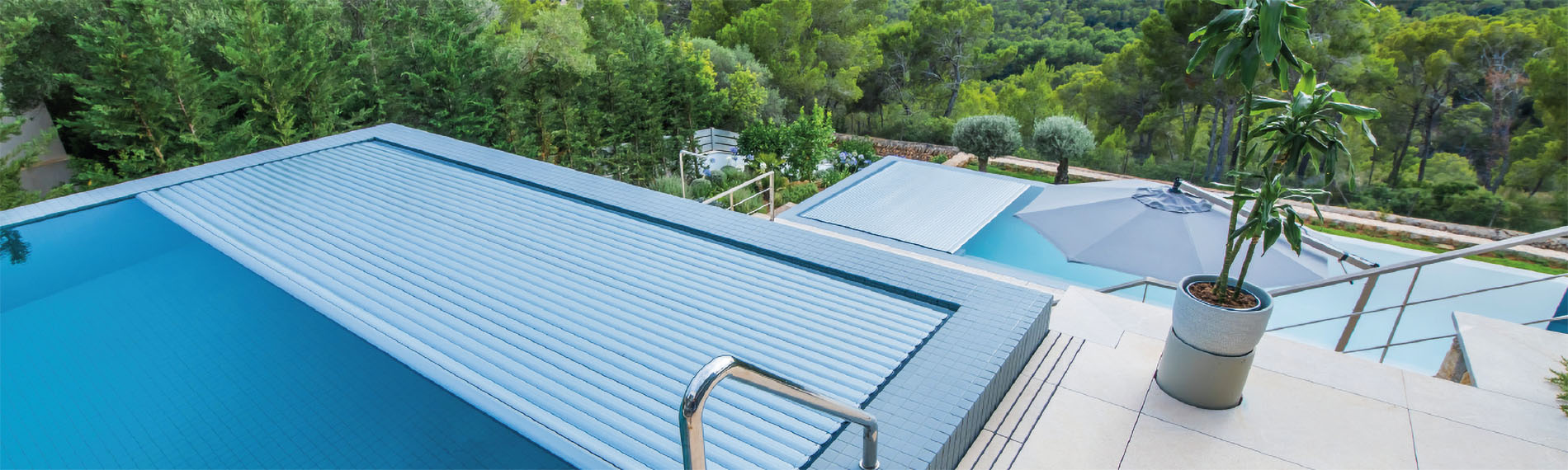
- a suitable pool cover to prevent evaporation,
- efficient pumps and filter technology,
- easily accessible maintenance areas,
- intelligent control of running times,
- water maintenance that avoids frequent complete changes,
- clear documentation of filling, maintenance and technical components .
This sounds unspectacular, but it is often the difference between a pool that works in the long term and a system that produces new costs every year.
This point is particularly important for properties that are not permanently occupied. A pool must run stably even when the owners are not on site. Technology, remote monitoring and a maintenance contract are therefore not a gimmick, but part of operational safety.
Old pools: Take a close look when buying real estate
Many properties in Mallorca already have a pool. At first, this seems reassuring: built, filled, visibly present. Legally, however, this is not always sufficient. Especially with older houses and fincas, it should be checked whether the pool is approved, correctly documented and traceable in the documents. Escritura, cadastre, building file of the municipality and the actual construction on site are important. Are the location and size correct? Is there an old license? Was the pool later extended? Is the technical room registered? Are there any paved areas that were never approved?
An improperly documented pool is not necessarily a problem. However, it should be known before the purchase. Because what seems like a plus point at the viewing appointment can later become an open question when it comes to renovation, sale or financing.
Pre-purchase inspection
| Document | What should be clarified |
|---|---|
| Escritura | Is the pool mentioned or is only the house described? |
| Cadastre | Do the location, area and inventory match the reality? |
| Community file | Is there a licencia or subsequent authorizations? |
| Technology | Are the technical room, pipes and drainage traceable? |
| Inventory | Has it been extended, deepened, moved or newly bordered? |
| Use | Private, communal, tourist or rented out? |
Legalization: No automatic amnesty
On Mallorca, there are numerous older buildings, facilities and uses in the suelo rústico that have never been fully legalized or documented. In 2024, the Consell de Mallorca introduced the extraordinary legalization procedure under Decree-Law 3/2024 for certain existing buildings, constructions, installations and uses in the suelo rústico. It concerns cases in which the urban planning illegality has lapsed and the restoration of legality can no longer be demanded. However, the procedure is not a blanket approval for every old pool. Among other things, it requires technical documentation, environmental measures, fees and, depending on the case, other conditions. There are also exceptions in which legalization is excluded, for example in certain locations in public areas, in coastal protection or road protection zones or in the event of other legal obstacles.
It is therefore important for owners not to simply renovate, extend or re-tile before the status has been checked. Anyone putting money into an old pool should know whether it is legally viable.
Private pools, community pools, tourist use: not everything is the same
A purely privately used pool in a detached house is subject to different requirements than a pool in a vacation complex, a hotel, a finca with tourist use or a communal facility. Balearic Islands Decree 53/1995 applies to pools in tourist accommodation and for collective use. Pools that are used exclusively by families and pools owned by communities of owners are expressly excluded. In addition, the state Real Decreto 742/2013 sets minimum technical and health criteria for pools. For private single-family pools of type 3B, at least Article 13 applies; for other private or communal uses, further obligations may apply.
The practical consequence: anyone who uses a property for tourism, rents it out or operates it jointly should have the pool issue checked not only in terms of building law, but also in terms of hygiene and liability law.
Terms: A permit does not last forever
A granted building permit is not a carte blanche without an expiration date. The LUIB stipulates that licenses contain deadlines for the start and end of work. If the municipal plan does not specify its own deadlines, six months apply for the start of construction and three years for completion. Extensions are possible, but must be justified and applied for in good time.
This is particularly important for projects that are planned in stages: first the house, then the garden, then the pool. If you wait too long or make significant changes during the construction phase, you should check whether the existing license is still valid or needs to be amended.
Before the pool takes shape: What owners should have checked firstA good pool project doesn't start with the lowest price, but with a clear inventory. This preliminary work is not cheap, but protects against expensive detours.
Checklist for owners
| Step | Why it is important |
|---|---|
| Print basic category | Suelo urbano, urbanizable or suelo rústico decide on the possibilities. |
| Community planning check | Each ayuntamiento works with its own planning principles and procedures. |
| Check inventory | Old extensions, terraces or technical rooms can become relevant. |
| Determine the pool size | In suelo rústico, 35 m² water surface area and 60 m³ volume are the limits for new pools. |
| Planning the technology early | Pump, filter, control, electricity and maintenance need space and access | .
| Water purification | Filling, re-filling, evaporation and possible restrictions are all part of the planning process | .
| Prepare the documents | Project, plans, memoria urbanística and technical evidence may be required. |
| Note deadlines | Approvals have terms and should not expire unused | .
| Save documentation | A clean file is important for sales, insurance and subsequent work | .
What makes good pool planning in Mallorca
A good pool doesn't just match the house. It fits the property, the use, the technology, the water consumption and the legal boundaries. This is particularly important in Mallorca because many properties are used seasonally, are empty for long periods or are managed from a distance. The pool should therefore not be planned in isolation. It makes sense to have a shared view of the garden, terrace, shading, building services, power supply, water care and maintenance. Those who combine all of this early on usually get the better solution: less improvised technology, less consumption, fewer conflicts with the permit and more safety during operation.
The most common mistakes when building a pool in Mallorca
First the design, then the building law
Many projects start with renderings, shapes and surfaces. However, the first decisive factor is what the property allows.
Underline the finca rules
In the suelo rústico, pool size and number are clearly limited. In particular, the 35 square meters of water surface area and 60 cubic meters of volume must be taken into account at all times.
Pushing technology into the corner
A poorly planned plant room makes maintenance more difficult, increases operating costs and can become relevant under building law.
Calculate water consumption
In Mallorca, water is at the heart of planning. Evaporation, refilling and maintenance are not a minor matter.
Take over old pools unchecked
When buying, an existing pool should not only be liked, but also documented
.The best pool is created before the first excavation
A pool can significantly enhance a property in Mallorca. It can make everyday life more pleasant, make the outdoor areas more usable and increase the value of a house. But only if it is properly planned in legal, technical and water management terms. In 2026, the following applies more than ever: pool construction in Mallorca is not a quick project. The decisive factors are the property category, approval, water, technology and documentation. Those who clarify these points early on will not only build more safely, but also more securely. And if you take a close look at an existing property, you will recognize in good time whether the existing pool is an advantage - or a task that first needs to be solved.
FAQ
Do you need a permit for a pool in Mallorca?
For a permanently installed pool, a municipal building permit is usually required. The respective Ayuntamiento is responsible. A simple notification should not be assumed, especially for excavation, technical room, pipes and paved side areas.
How big can a pool be on a finca in Mallorca?For new pools in the suelo rústico the following applies: maximum 35 square meters of water surface and a maximum volume of 60 cubic meters. In addition, no more than one pool may be built per finca.
Is one comunicación previa sufficient for one pool?
For smaller jobs, a comunicación previa may be sufficient. For a new in-ground pool, a licencia urbanística is usually the safer option, as excavation, technology and structural work are involved. The municipality should confirm this in advance.
What needs to be checked before buying a property with an existing pool?
It is important to check the Escritura, cadastre, municipal building file, existing licenses, actual size and location of the pool as well as the technical room and drainage. An existing pool should not only be visible, but also legally traceable.
Can an old pool in Mallorca be legalized retroactively?
This may be possible, but is not guaranteed. Extraordinary legalization in the suelo rústico only applies to certain proven cases and is subject to conditions. A professional assessment is advisable before redevelopment, sale or expansion.
What role does water play in pool construction in Mallorca?
Water is a key planning issue. New buildings and comprehensive reforms must include water-saving installations; in the suelo rústico, rainwater utilization is also relevant in the planning. Pool covers, efficient technology and maintenance help to reduce consumption and evaporation